If you’re in senior living marketing right now, you already know the feeling: the market is moving fast, the prospects are savvier than ever, and what worked three years ago just doesn’t cut it anymore. The good news? The data tells a compelling story — and for communities willing to adapt, 2026 is full of opportunity.
Here’s a look at the biggest marketing trends shaping the senior living industry this year, and what they mean for how you reach, connect with, and convert today’s prospects.
AI Is Rewriting the Rules of Online Search
For years, senior living marketing was built on a reliable foundation: invest in SEO, drive traffic to your website, and convert visitors into leads. That foundation is cracking.
Platforms like ChatGPT, Google’s Gemini, and Perplexity are changing how families research senior living options. Instead of clicking through search results, users are getting answers directly inside AI interfaces — no website visit required. According to reporting from Senior Housing News, organic click-through rates have dropped significantly since mid-2024 for searches with AI-powered summaries. One Pew Research survey found that users who encounter an AI summary click on traditional search results only 8% of the time — compared to 15% when no AI summary was present.
What this means for you: SEO still matters, but it’s no longer enough on its own. Communities need to think about AI optimization (AIO) — creating content that AI tools can cite, surface, and reference in their answers. Think authoritative, helpful, frequently updated content that answers real questions prospects are typing into ChatGPT.
Heritage Communities CMO Lacy Jungman summed it up well in a recent Senior Housing News interview: “The top of the funnel today exists in these AI overviews. And so it’s a different strategy, which requires a different set of skills.”
Boomers Expect Transparency — and They’ll Move On If They Don’t Get It
The oldest Baby Boomers turn 80 in 2026. This isn’t a future demographic shift — it’s happening now. And this generation has different expectations than any that came before them.
According to NIC MAP data, senior housing occupancy reached 89.1% at the end of 2025 — the fourth consecutive year of gains over 200 basis points. With demand outpacing supply, communities may feel they can afford to hold back. But today’s Boomer prospect is doing deep research before they ever call. They want pricing. They want specifics. They want to know why your community is right for them — not a generic “vibrant, welcoming” promise.
What this means for you: Stop gatekeeping. Transparency is your best salesperson. Communities that put pricing, floor plans, and honest value propositions front and center are qualifying better leads and shortening sales cycles. In a market this competitive, making a prospect work to find basic information is a fast way to lose them.
The Emotional Buyer Journey Is Your Competitive Edge
Here’s something senior living marketers know intuitively but don’t always act on: the decision to move into a senior community is one of the most emotional decisions a family makes. It’s not a transaction. It’s a turning point.
Marketing in 2025 moved toward personalization for exactly this reason — and the trend is accelerating. According to industry insights from Senior Living Smart, the most successful operators are building brand experiences that feel personal from first touchpoint to move-in, not just during the sales conversation.
What this means for you: Map the full prospect journey and find the gaps. Are your follow-up emails warm or generic? Does your website feel like a home or a brochure? Are your current residents and families becoming brand ambassadors? User-generated content, genuine testimonials, and resident referral programs are today’s most credible marketing — and Boomers trust them far more than polished ad campaigns.

Lifestyle-Driven Messaging Is Outpacing Care-Led Messaging
The senior living sector has historically led with care. Safety, support, health services. And those things still matter — deeply. But today’s incoming residents don’t want to be marketed to as people who need help. They want to be marketed to as people choosing their next chapter.
A McKinsey analysis of the senior housing market notes that many potential residents are simply unaware of what modern senior living actually offers, or see it as a nursing home by another name. Changing that perception is a marketing challenge — and an opportunity.
What this means for you: Lead with possibility, not limitation. Show what residents are doing: the travel programs, the fitness classes, the intergenerational events, the social connections. Aspirational, lifestyle-driven content consistently outperforms care-led messaging with Boomer audiences. Think less “safe and supported” and more “living boldly, with backup.”
The Supply Constraint Is a Marketing Tailwind — But Not Forever
Right now, demand is dramatically outpacing supply. NIC MAP projects occupancy could surpass 90% industry-wide in 2026, potentially the highest level in 20 years of data collection. With inventory growth at just 1% in 2025 — the lowest since NIC began tracking — stabilized communities are operating with less direct competition than they’ve seen in over a decade.
But the pipeline is coming. Industry experts at NIC note that when supply dips this low, it historically precedes a real estate growth cycle within five years. The communities being marketed today are building brand equity for when that competition arrives.
What this means for you: Don’t let strong occupancy make you complacent. Now is the time to invest in brand equity, digital infrastructure, and marketing systems — not coast on a tight market. The communities that treat this window as an opportunity to build real, lasting marketing strength will be the ones with waiting lists when new inventory opens nearby.
The Real Decision-Maker Is Often a Son, Daughter, or Grandchild
Behind nearly every senior living inquiry is a family member carrying a weight most marketing doesn’t acknowledge. They’re juggling their own career, their own family, and now the profound responsibility of helping someone they love find a place to live — often while processing grief, guilt, and uncertainty all at once.
This isn’t a fringe experience. Research consistently shows that adult children are involved in the senior living decision 73% of the time, and of those, it’s the adult daughter leading the search 71% of the time. But the picture is becoming more generationally layered. According to AARP, approximately 24% of all family caregivers in the United States are now millennials — making them the fastest-growing caregiver group in the country. An estimated 9.5 million millennials currently serve as primary caregivers for a parent or grandparent, most while also holding down full-time jobs.
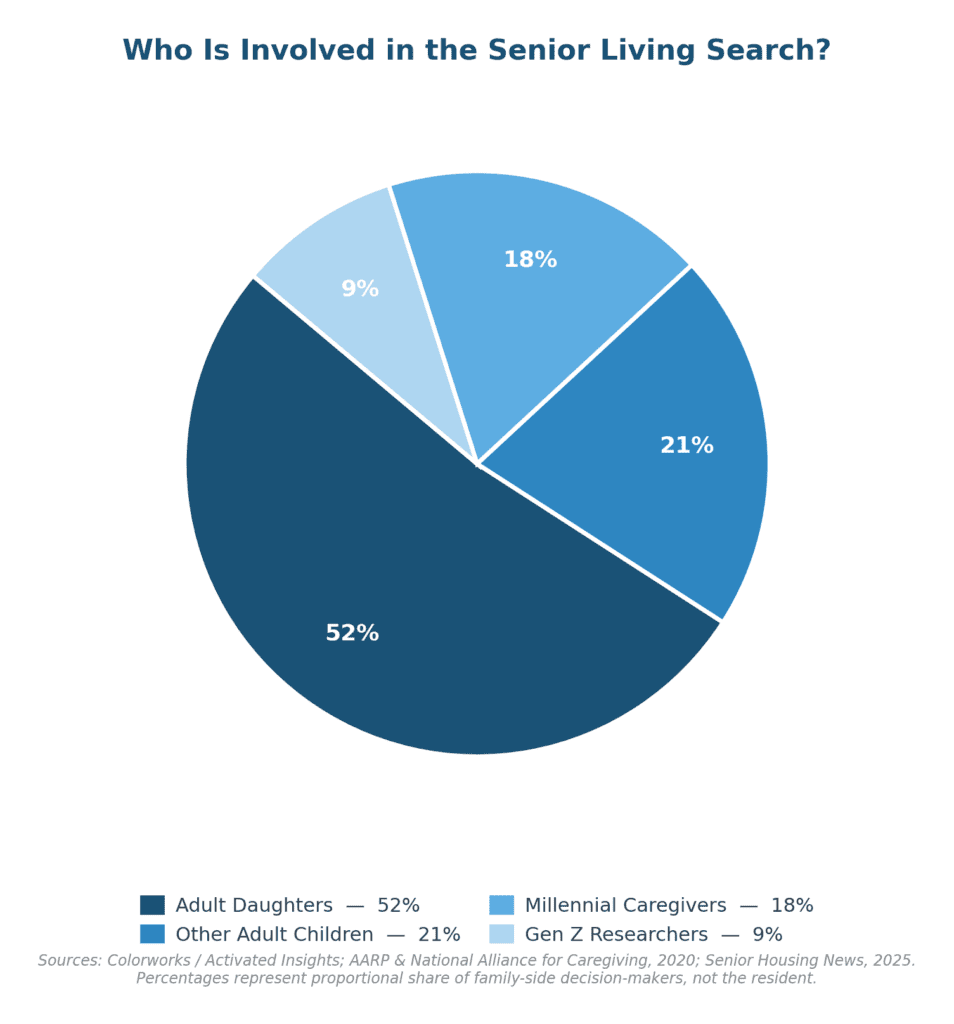
And it doesn’t stop there. Senior Housing News reporting from 2025 highlighted something marketers can’t afford to ignore: Gen X adult children helping their Boomer parents are increasingly handing off the online research to their own Gen Z children. That means a single senior living inquiry may pass through three generations of family members before anyone picks up the phone.
Each of those family members is searching differently. The adult daughter is on Google at 11 pm, comparing floor plans. Her millennial sibling is asking ChatGPT for a quick summary of nearby options. Her college-aged nephew is scrolling Instagram to see if the community looks like a place his grandparent would actually want to be. And a Caring.com survey found that across all of these family researchers, only 16% correctly understand what senior care actually costs — meaning most arrive underprepared, overwhelmed, and in need of guidance more than a sales pitch.
What this means for you: Your marketing audience isn’t one person — it’s a family ecosystem, often spread across generations and search platforms. The communities that win aren’t just speaking to the resident; they’re speaking to everyone who loves them. That means content that’s easy to find on AI platforms (for the quick researcher), transparent pricing (for the practical planner), emotional reassurance (for the guilt-ridden adult child), and visuals that feel real and warm (for the younger family member doing a gut-check scroll). Marketing to the whole family — with empathy at the center — is one of the most underutilized advantages in senior living today.
The Bottom Line
Senior living marketing in 2026 isn’t about chasing the newest tool or trend. It’s about understanding a rapidly evolving buyer — one who is digitally fluent, emotionally driven, and expecting to be treated like the savvy consumer they are.
And increasingly, that buyer isn’t just the resident. It’s their family — the adult daughter doing late-night research, the millennial son comparing options on his lunch break, the Gen Z grandchild doing a quick scroll to make sure the place feels right. Communities that market to the whole family, with clarity and genuine warmth, will stand apart in a market that too often forgets the human story behind every inquiry.
The data has never been more favorable for this industry. The question is whether your marketing is keeping pace. If you’re interested in working with Paper PR, Book a Consultation.
Sources
- National Investment Center for Seniors Housing & Care (NIC MAP). Senior Housing Market Outlook & Quarterly Data Reports, 2024–2026. nic.org
- Senior Housing News. “How AI Searches Are Changing Senior Living Digital Marketing.” November 2025. seniorhousingnews.com
- Senior Housing News. “Senior Living Operators Embrace Authenticity in Digital Marketing Amid ‘New Frontier’ of AI Searches.” January 2026.
- Senior Housing News. “Top Senior Living Trends for 2026.” January 2026.
- McKinsey & Company. “How Private Investment Can Improve Senior Housing Options.” March 2025. mckinsey.com
- McKinsey Health Institute. Healthy Longevity Research & Global Aging Survey. 2023–2025.
- Love & Company. “Looking Ahead: 5 Key Marketing Trends for Senior Living in 2026.” loveandcompany.com
- PwC / Urban Land Institute. Emerging Trends in Real Estate® 2026.
- Creating Results. “2026 Senior Living Marketing: What’s In, What’s Next.” February 2026. creatingresults.com
- Senior Living Smart. “Senior Living Marketing Trends & Predictions for 2025.” December 2025.
- Caring.com. “Gen Z Overwhelmingly Willing to Take Care of Their Parents As They Age.” caring.com
- AARP & National Alliance for Caregiving. Caregiving in the United States. 2020.
- Senior Housing News. “Beyond the Boomers: How Gen X Is Shaping the Future of Senior Living.” February 2025.
- Colorworks, Inc. “Senior Living Marketing: Targeting Adult Daughters.” colorworksinc.com